


Cheating and test theft take many forms in the testing space. All have been affected in one way or another by the growing accessibility and lowered cost of high-tech tools that make cheating easy, affordable, and almost undetectable.
In this report, we’ve donned our technological black hats to peer down at the level where the fraudsters play and understand their games. First, we’ll discuss the power, affordability, and accessibility of modern hidden cameras. Next, we’ll show you just how easy it is to use hidden cameras, even (and almost especially) when a proctor is present. Finally, we’ll talk about ways you can make it more difficult for these methods to work.
In this report, we will not be revealing anything that fraudsters don’t already know. It may be uncomfortable to stoop to their level and explore our own vulnerabilities, but it’s the only way we can beat them. Let’s dive in: Cameras are categorized into three different areas: Hidden objects, small and disguisable, and wearable.


How do testing programs detect these hidden cameras? If there are so many different variations, what are you supposed to look for? It’s not easy, especially since these cameras are designed to be hidden. However, there are a few things you can look for:

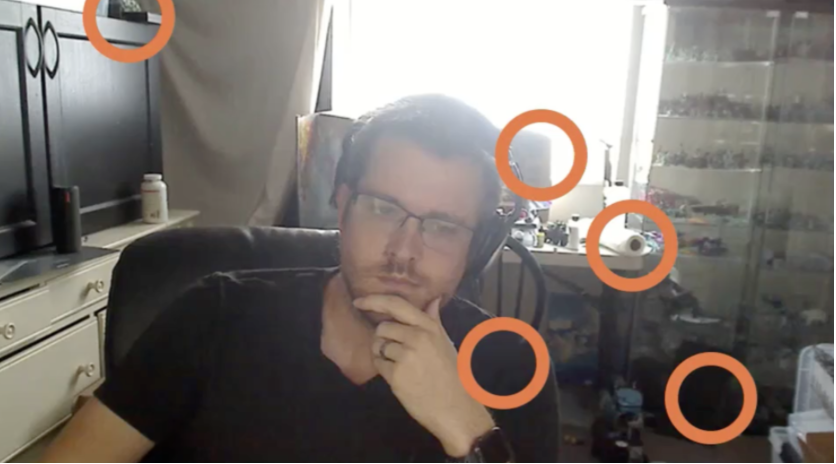
What’s more troubling? There’s more here than meets the eye (and we’ve just established that “what meets the eye” is still pretty hard to see). There are three additional cameras in the room, all with clean shots of the screen, and all virtually undetectable in a proctored room sweep. Because of the webcam’s limited field of vision, these cameras are “off-screen,” and would likely be missed during a sweep of the room. Why? Because room sweeps are typically focused on looking for additional people in the room, illicit materials in the workspace, and other more obvious things.
Let’s look at these cameras. Up on the right platform, there is a very nice camera pointing directly at the screen. On the top left, where you cannot see, is the home camera Chris uses to watch his dogs when he’s away. Then, directly below the webcam, Chris has taped a button cam from Amazon that can collect everything on the screen without being detected by even the most thorough room sweep.


Here is another example of Andrew looking at his screen, which has test material displayed. Can you spot the hidden camera in this photo?
Like before, Andrew has used a dark-colored shirt to disguise a camera. This time, it’s taped to his chest.
On Amazon, that camera goes for $47 (and Andrew got a 10% off coupon, too). The camera broadcasts a Wi-Fi signal to send real-time images to a smartphone app that displays all that’s being recorded.

To test the hidden cameras, we recorded practice SAT questions from Khan Academy. The glasses were effective when the browser was zoomed to 150%. The hidden camera taped to Andrew’s shirt was effective when the browser was zoomed to 200%. Both tests were done on a 13-inch laptop. Both cameras can capture all the text, images, and mathematical notation, making it sufficient for stealing test content. The glasses have a slightly higher quality camera, but the second camera was easier to conceal.
Suppose a thief records a test session. How will they convert that video into text for wide distribution? Cue artificial intelligence. Andrew took one frame from the glasses camera and fed it into Google’s Vision API, and overall the results were extremely good.
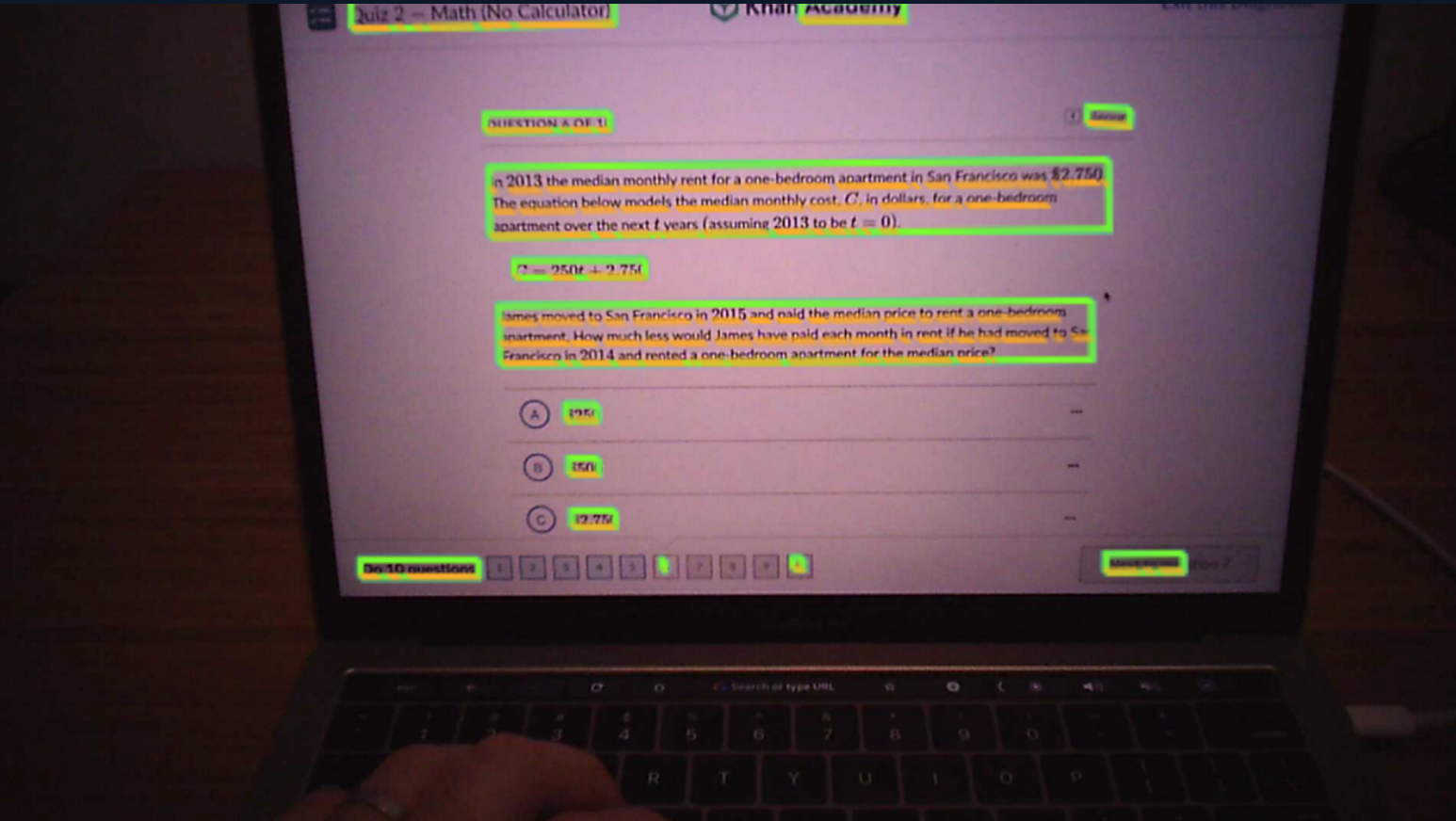
Google’s Vision API recreated the text quite well. The green boxes indicate the text that the API recognized. All the text is correct, but the equation is not quite right. There is text around the page that is recognized as well, though that text isn’t part of the test question. There are going to be slight mistakes coming out of AI. It would be difficult to handle questions that span multiple frames, but overall, this would be a feasible way to extract text from video content.

This braindump site advertises actual tests. You can pass any exam at any time. They claim IT professionals have verified their answers and that the questions are always up-to-date. Some sites advertise thousands of different exams, many for as low as $20.
The sad reality is that most IT tests can be found this way. The higher the stakes become, the more incentive there is to steal. Browse through the news and you’ll find this phenomenon holds true in K-12 testing, higher education, certification testing, medical licensing, and other industries as well.
The information in this paper represents a rude awakening: stealing your test content is more accessible and less detectable than ever before. Hidden cameras are a significant security threat. It is very difficult, especially for online proctors, to locate any hidden cameras. Highstakes test questions are valuable, and bad actors can profit from selling that content.
Instead of relying solely on proctors, testing programs must adopt preventative measures and measures that detect and deter the clandestine capture of valuable intellectual property.


